

By Laura Ispas, MD
Allergy Asthma & Immunology Institute
Leesburg/Lansdowne, Virginia
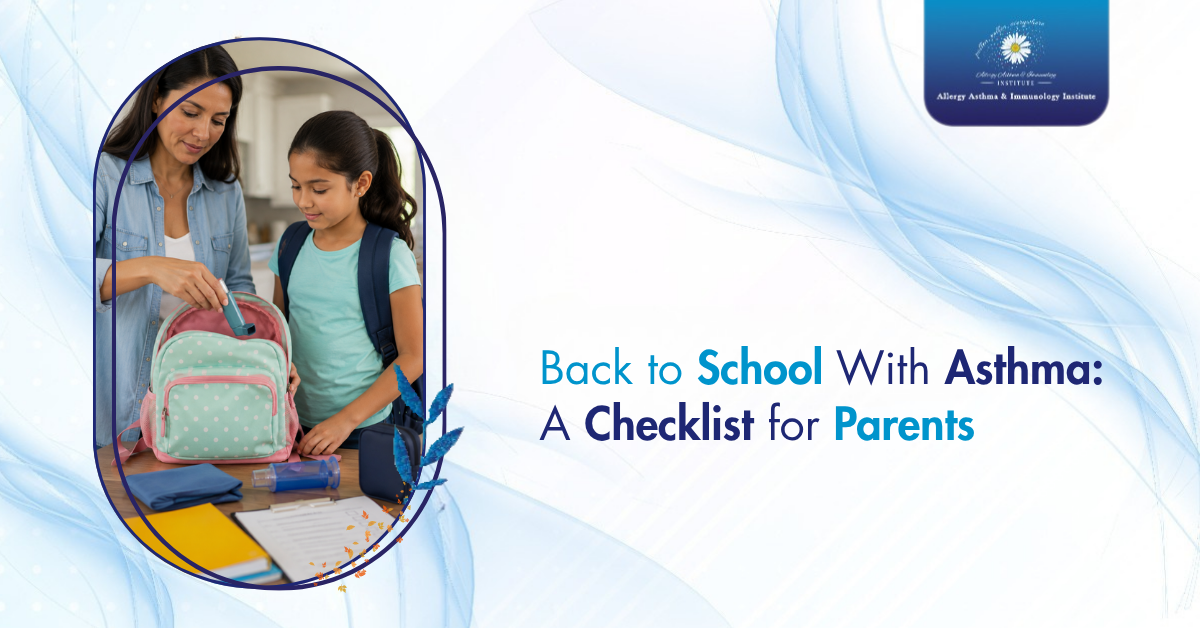
The beginning of a new school year is an important time for parents of children with asthma to make sure medications, school forms and the child’s asthma treatment plan are ready.
Preparing ahead can help prevent missed school days, unnecessary urgent-care visits and situations in which a child needs medication but does not have it available.
1. Check Every Asthma Medication
Before school starts, look at every inhaler and medication your child uses.
Check:
- Medication name
- Expiration date
- Remaining doses
- Correct dose prescribed for your child
- Condition of the inhaler or device
- Whether a refill is needed
Do not wait until the first asthma episode at school to discover that an inhaler is empty or expired.
2. Make Sure Rescue Medication Is Available
Children with asthma may be prescribed a quick-relief medication such as an albuterol-containing inhaler.
Parents should know:
- Where the rescue inhaler will be kept at school
- Whether the school requires medication to remain with the nurse
- Whether the child is permitted and medically appropriate to carry the inhaler
- Whether an additional inhaler is needed for sports or after-school activities
Follow your child’s individualized prescription and school requirements.
3. Don’t Forget the Spacer
If your child’s metered-dose inhaler is intended to be used with a spacer or valved holding chamber, make sure the appropriate device is available.
Correct inhaler technique is extremely important. Even an appropriate medication may not work as intended when inhaler technique is poor.
Ask your healthcare provider to review your child’s inhaler technique periodically.
4. Understand Rescue vs. Controller Medication
A rescue medication is intended to provide rapid relief of asthma symptoms according to the child’s treatment plan.
A controller medication is generally taken regularly to help control airway inflammation and prevent asthma symptoms and exacerbations.
Children and caregivers should understand which medication serves which purpose.
Never change or discontinue prescribed controller therapy simply because the child is feeling better without discussing it with the treating clinician.
5. Complete School Forms Early
Depending on the child’s needs and the school’s requirements, families may need:
- Medication authorization forms
- Asthma Action Plan
- Authorization for rescue medication
- Emergency contact information
- Permission for self-carry or self-administration when appropriate
Try to complete these documents before school begins rather than waiting until medication is urgently needed.
6. Tell the School About Important Triggers
Asthma triggers differ among children and can include:
- Viral respiratory infections
- Exercise
- Pollens
- Mold
- Dust mites
- Animal allergens
- Smoke
- Strong odors
- Cold air
- Other environmental exposures
Teachers, coaches and the school nurse should know about important triggers when relevant to the child’s safety.
7. Watch Exercise Carefully
Children with well-controlled asthma should generally be able to participate in normal physical activity.
However, coughing, wheezing, chest tightness or unusual shortness of breath during exercise deserves attention.
If your child repeatedly has difficulty participating in sports or physical education because of breathing symptoms, discuss this with the treating clinician.
8. Recognize Signs That Asthma May Not Be Well Controlled
Contact your child’s healthcare provider if you notice:
- Frequent coughing
- Nighttime cough or awakening
- Wheezing
- Shortness of breath
- Difficulty keeping up with other children
- Increasing rescue medication use
- Repeated visits to the school nurse for asthma
- Asthma symptoms interfering with school attendance
- Recurrent urgent-care or emergency visits
The asthma treatment plan may need reassessment.
9. Consider the Role of Allergies
Asthma and environmental allergies frequently occur together.
A child with significant nasal congestion, sneezing, itchy eyes or seasonal symptoms may benefit from an allergy evaluation.
Identifying and treating relevant allergic triggers may be an important part of comprehensive asthma management.
10. Schedule the Visit Before There Is a Problem
A pre-school or back-to-school asthma visit provides an opportunity to:
- Review asthma control
- Review medications
- Check inhaler technique
- Review the need for refills
- Discuss environmental triggers
- Update the Asthma Action Plan when appropriate
- Complete necessary school medication forms
Back-to-School Asthma Checklist
- Check medication expiration dates
- Obtain necessary refills
- Confirm rescue inhaler availability
- Check spacer/holding chamber
- Review inhaler technique
- Complete school medication forms
- Update Asthma Action Plan when appropriate
- Inform the school about important triggers
- Prepare for sports and after-school activities
- Schedule an asthma/allergy follow-up if symptoms are not well controlled
Start the School Year Prepared
A little preparation before school starts can make a significant difference for a child with asthma.
Allergy Asthma & Immunology Institute
Laura Ispas, MD
Leesburg/Lansdowne, Virginia
Across from Inova Loudoun Hospital
Contact our office to schedule a back-to-school asthma/allergy visit, medication review or completion of required school forms.
This article is for general educational purposes. Every child’s asthma treatment and emergency plan should be individualized by the treating healthcare professional.